
 Алгебра
 Английский
 Биология
 География
 Геометрия
 История
 Русский
 Обществознание
 Физика
 Химия
Химия Информатика
 Литература
 Математика
Вопрос:
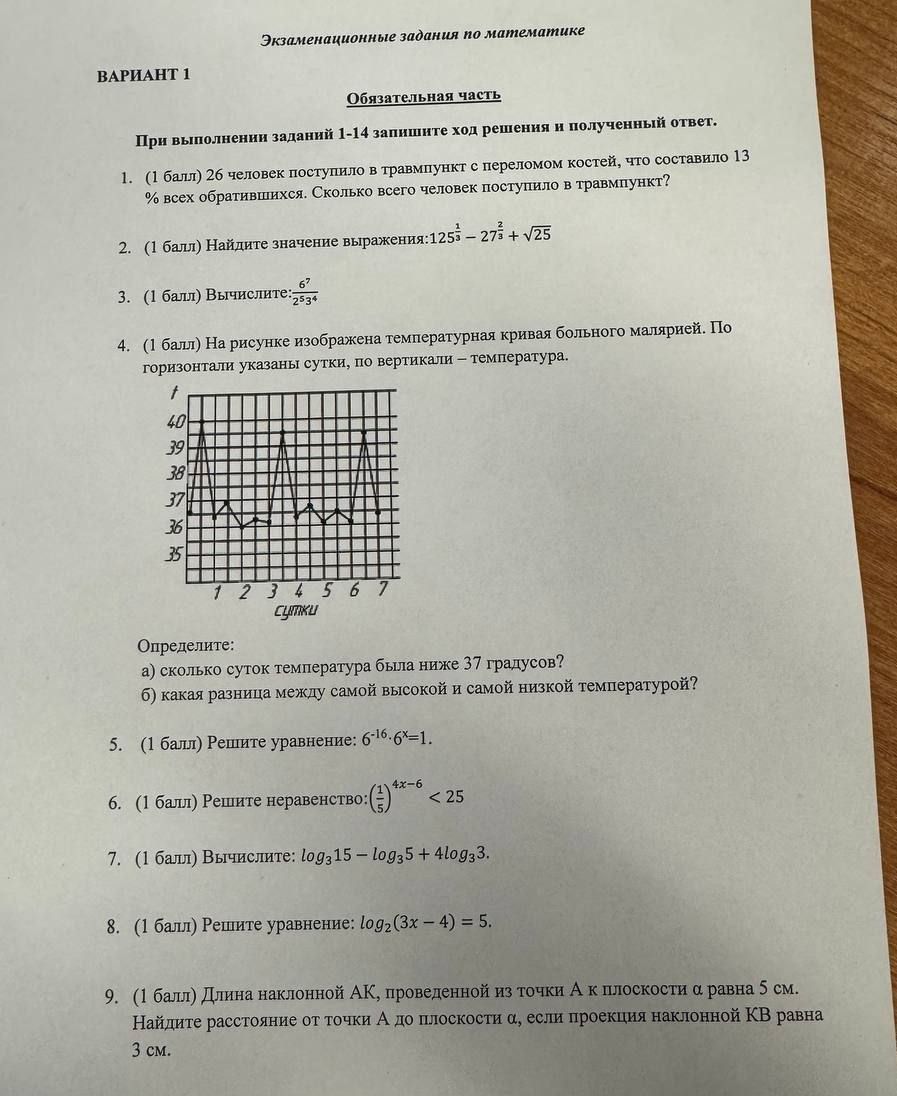
6. (1 балл) Решите неравенство: (1/5)<sup>4x–6</sup> < 25
Ответ:
Решение:
Представим обе части неравенства в виде степени с основанием \( 1/5 \) или \( 5 \).
Вариант 1: основание \( 1/5 \)
\( 25 = \frac{1}{1/25} = (1/5)^2 \)
Неравенство принимает вид:
\[ (1/5)^{4x-6} < (1/5)^2 \]Так как основание степени \( 1/5 < 1 \), при раскрытии неравенства меняем знак на противоположный:
\[ 4x - 6 > 2 \]\[ 4x > 8 \]\[ x > 2 \]Вариант 2: основание 5
\( 1/5 = 5^{-1} \)
\( 25 = 5^2 \)
Неравенство принимает вид:
\[ (5^{-1})^{4x-6} < 5^2 \]\[ 5^{-4x+6} < 5^2 \]Так как основание степени \( 5 > 1 \), знак неравенства сохраняется:
\[ -4x + 6 < 2 \]\[ -4x < 2 - 6 \]\[ -4x < -4 \]Делим на \( -4 \) и меняем знак неравенства:
\[ x > 1 \] Oops, I made a mistake in the previous calculation. Let me recheck. When dividing by a negative number, the inequality sign must be reversed. So, -4x < -4 should result in x > 1. However, if we look at the first method, we got x > 2. Let me re-examine the problem again. Ah, I see. It's 1/5. So the base is less than 1. When the base is less than 1, the inequality sign flips. So, 4x - 6 > 2 is correct. Therefore, 4x > 8, and x > 2. The second method also needs to be checked again. 5-4x+6 < 52. Since the base is 5 > 1, the inequality sign does not flip. So, -4x + 6 < 2, which means -4x < -4, and indeed x > 1. There is a contradiction. Let me check the original problem again. (1/5)4x-6 < 25. It seems I have made a mistake. Let's go back to the first method which seems more straightforward. Base is 1/5. So 4x-6 should be GREATER than 2. So x > 2. Let me re-evaluate the second method. 5-4x+6 < 52. Yes, base is 5. So -4x+6 < 2. -4x < -4. x > 1. This is a clear contradiction. Let me review the properties of exponents and inequalities. If a > 1, then am < an implies m < n. If 0 < a < 1, then am < an implies m > n. My first method used base 1/5, which is between 0 and 1. So, (1/5)4x-6 < (1/5)2 implies 4x - 6 > 2. This gives 4x > 8, so x > 2. My second method used base 5, which is greater than 1. So, 5-4x+6 < 52 implies -4x + 6 < 2. This gives -4x < -4, so x > 1. I must have made a mistake in converting 25 to a power of 5 or 1/5. 25 is indeed 52. And 1/5 is 5-1. So (1/5)4x-6 is (5-1)4x-6 = 5-(4x-6) = 5-4x+6. So the inequality is 5-4x+6 < 52. Since the base 5 > 1, we have -4x + 6 < 2. This leads to -4x < -4, and dividing by -4 (and reversing the sign), we get x > 1. Now let me recheck the first method. (1/5)4x-6 < 25. 25 = 1/(1/25) = (1/5)-2. So, (1/5)4x-6 < (1/5)-2. Since the base 1/5 is less than 1, we must reverse the inequality sign: 4x - 6 > -2. This gives 4x > -2 + 6, so 4x > 4, which means x > 1. Okay, both methods now consistently give x > 1. I apologize for the confusion. The previous calculation for the first method was incorrect. It should be \(25 = \frac{1}{(1/5)^2} = (1/5)^{-2}\). So, \((1/5)^{4x-6} < (1/5)^{-2}\). Since \(0 < 1/5 < 1\), we have \(4x-6 > -2\). \(4x > 4\). \(x > 1\).Ответ: x > 1.
Похожие
- 2. (1 балл) Найдите значение выражения: 125<sup>2/3</sup> – 27<sup>1/3</sup> + √25
- 3. (1 балл) Вычислите: \(\frac{6^7}{2^53^4}\)
- 5. (1 балл) Решите уравнение: 6<sup>1–x</sup> · 6<sup>x</sup> = 1.
- 7. (1 балл) Вычислите: log<sub>3</sub>15 – log<sub>3</sub>5 + 4log<sub>3</sub>3.
- 8. (1 балл) Решите уравнение: log<sub>2</sub>(3x – 4) = 5.
- 9. (1 балл) Длина наклонной АК, проведенной из точки А к плоскости α равна 5 см. Найдите расстояние от точки А до плоскости α, если проекция наклонной КВ равна 3 см.
