
 Алгебра
 Английский
 Биология
 География
 Геометрия
 История
 Русский
 Обществознание
 Физика
 Химия
Химия Информатика
 Литература
 Математика
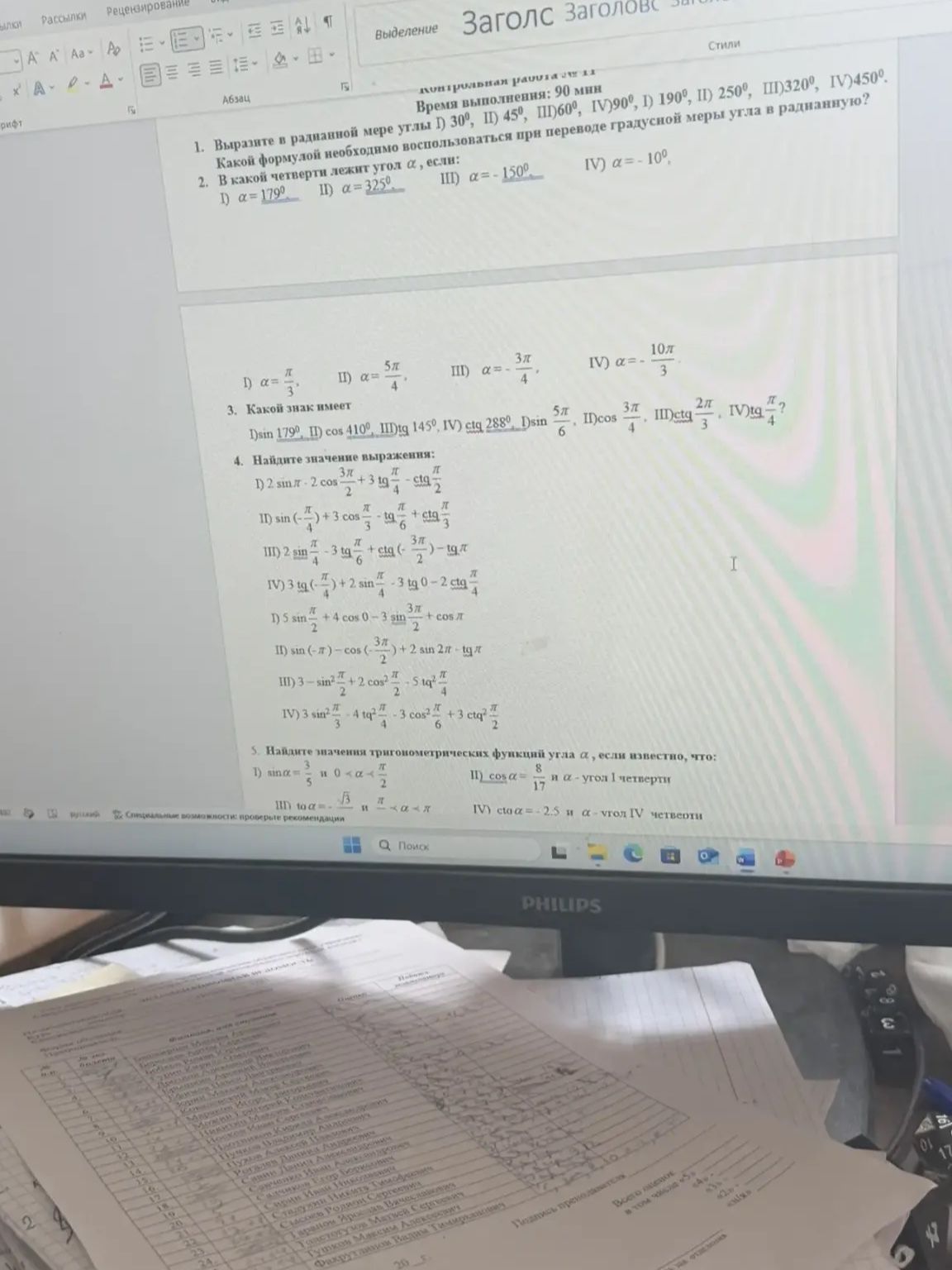
5. Найдите значения тригонометрических функций угла α, если известно, что: I) sin α = 3/5 и 0 < α < π/2 II) cos α = -8/17 и α - угол I четверти III) tg α = √3 и -π < α < -π/2 IV) ctg α = -2.5 и α - угол IV четверти
Ответ:
5. Нахождение значений тригонометрических функций:
I) sin α = 3/5 и 0 < α < π/2 (I четверть)
В I четверти все функции положительны.
Используем основное тригонометрическое тождество: \( \sin^2\alpha + \cos^2\alpha = 1 \).
\( \cos^2\alpha = 1 - \sin^2\alpha = 1 - (3/5)^2 = 1 - 9/25 = 16/25 \).
\( \cos\alpha = \sqrt{16/25} = 4/5 \) (так как \( \alpha \) в I четверти, \( \cos\alpha \) положительный).
\( \operatorname{tg}\alpha = \frac{\sin\alpha}{\cos\alpha} = \frac{3/5}{4/5} = 3/4 \).
\( \operatorname{ctg}\alpha = \frac{1}{\operatorname{tg}\alpha} = \frac{4}{3} \).
II) cos α = -8/17 и α - угол I четверти
Внимание: Условие противоречиво. В I четверти \( \cos\alpha \) должен быть положительным. Предположим, что \( \alpha \) находится во II четверти, где \( \cos\alpha \) отрицателен.
\( \sin^2\alpha = 1 - \cos^2\alpha = 1 - (-8/17)^2 = 1 - 64/289 = (289 - 64)/289 = 225/289 \).
\( \sin\alpha = \sqrt{225/289} = 15/17 \) (так как \( \alpha \) во II четверти, \( \sin\alpha \) положительный).
\( \operatorname{tg}\alpha = \frac{\sin\alpha}{\cos\alpha} = \frac{15/17}{-8/17} = -15/8 \).
\( \operatorname{ctg}\alpha = \frac{1}{\operatorname{tg}\alpha} = -8/15 \).
III) tg α = √3 и -π < α < -π/2 (III четверть)
В III четверти sin и cos отрицательны, tg положительный.
Если \( \operatorname{tg}\alpha = \sqrt{3} \), то \( \alpha = \frac{\pi}{3} + n\pi \). Учитывая, что \( \alpha \) в III четверти, \( \alpha = \frac{\pi}{3} + \pi = \frac{4\pi}{3} \) или \( \alpha = \frac{\pi}{3} - 2\pi = -\frac{5\pi}{3} \). Но нам нужно \( \alpha \) в промежутке \( (- \pi, - \frac{\pi}{2}) \). Это соответствует \( \alpha = -\frac{2\pi}{3} \).
\( \sin\alpha = \sin(-\frac{2\pi}{3}) = -\frac{\sqrt{3}}{2} \).
\( \cos\alpha = \cos(-\frac{2\pi}{3}) = -\frac{1}{2} \).
\( \operatorname{ctg}\alpha = \frac{1}{\operatorname{tg}\alpha} = \frac{1}{\sqrt{3}} \).
IV) ctg α = -2.5 и α - угол IV четверти
В IV четверти sin отрицателен, cos положителен, tg и ctg отрицательны.
\( \operatorname{tg}\alpha = \frac{1}{\operatorname{ctg}\alpha} = \frac{1}{-2.5} = -0.4 = -2/5 \).
Используем тождество \( 1 + \operatorname{tg}^2\alpha = \frac{1}{\cos^2\alpha} \).
\( 1 + (-2/5)^2 = 1 + 4/25 = 29/25 = \frac{1}{\cos^2\alpha} \).
\( \cos^2\alpha = 25/29 \).
\( \cos\alpha = \sqrt{25/29} = 5/\sqrt{29} = \frac{5\sqrt{29}}{29} \) (так как \( \alpha \) в IV четверти, \( \cos\alpha \) положительный).
\( \sin\alpha = \operatorname{tg}\alpha \cdot \cos\alpha = (-2/5) \cdot \frac{5}{\sqrt{29}} = -2/\sqrt{29} = -\frac{2\sqrt{29}}{29} \) (так как \( \alpha \) в IV четверти, \( \sin\alpha \) отрицательный).
Ответ: I) \( \cos\alpha = 4/5, \operatorname{tg}\alpha = 3/4, \operatorname{ctg}\alpha = 4/3 \). II) (при условии II четверти) \( \sin\alpha = 15/17, \operatorname{tg}\alpha = -15/8, \operatorname{ctg}\alpha = -8/15 \). III) \( \sin\alpha = -\sqrt{3}/2, \cos\alpha = -1/2, \operatorname{ctg}\alpha = 1/\sqrt{3} \). IV) \( \cos\alpha = \frac{5\sqrt{29}}{29}, \sin\alpha = -\frac{2\sqrt{29}}{29}, \operatorname{tg}\alpha = -2/5 \).
Похожие
- 1. Выразите в радианной мере углы 1) 30°, II) 45°, III) 60°, IV) 90°, 1) 190°, II) 250°, III)320°, IV)450°. 2. В какой четверти лежит угол α, если: I) α = 1790 II) α = 3250 III) α = -150° IV) α = -10°
- 3. Какой знак имеет: I) α = π/3 II) α = 5π/4 III) α = -3π/4 IV) α = -10π/3
- 4. Найдите значения выражения: I) 2 sin π/3 ⋅ cos π/3 + 3 tg π/4 - ctg π/2 II) sin (-π/3) + cos π/6 - tg π/3 + ctg π/3 III) 2 sin π/6 - 3 tg π/4 + ctg π/6 IV) 3 tg π/4 + 2 sin π/2 - 3 tg 0 - 2 ctg π/4 V) 5 sin π/4 + 4 cos 0 - 3 sin π/2 + cos π
