
 Алгебра
 Английский
 Биология
 География
 Геометрия
 История
 Русский
 Обществознание
 Физика
 Химия
Химия Информатика
 Литература
 Математика
Вопрос:
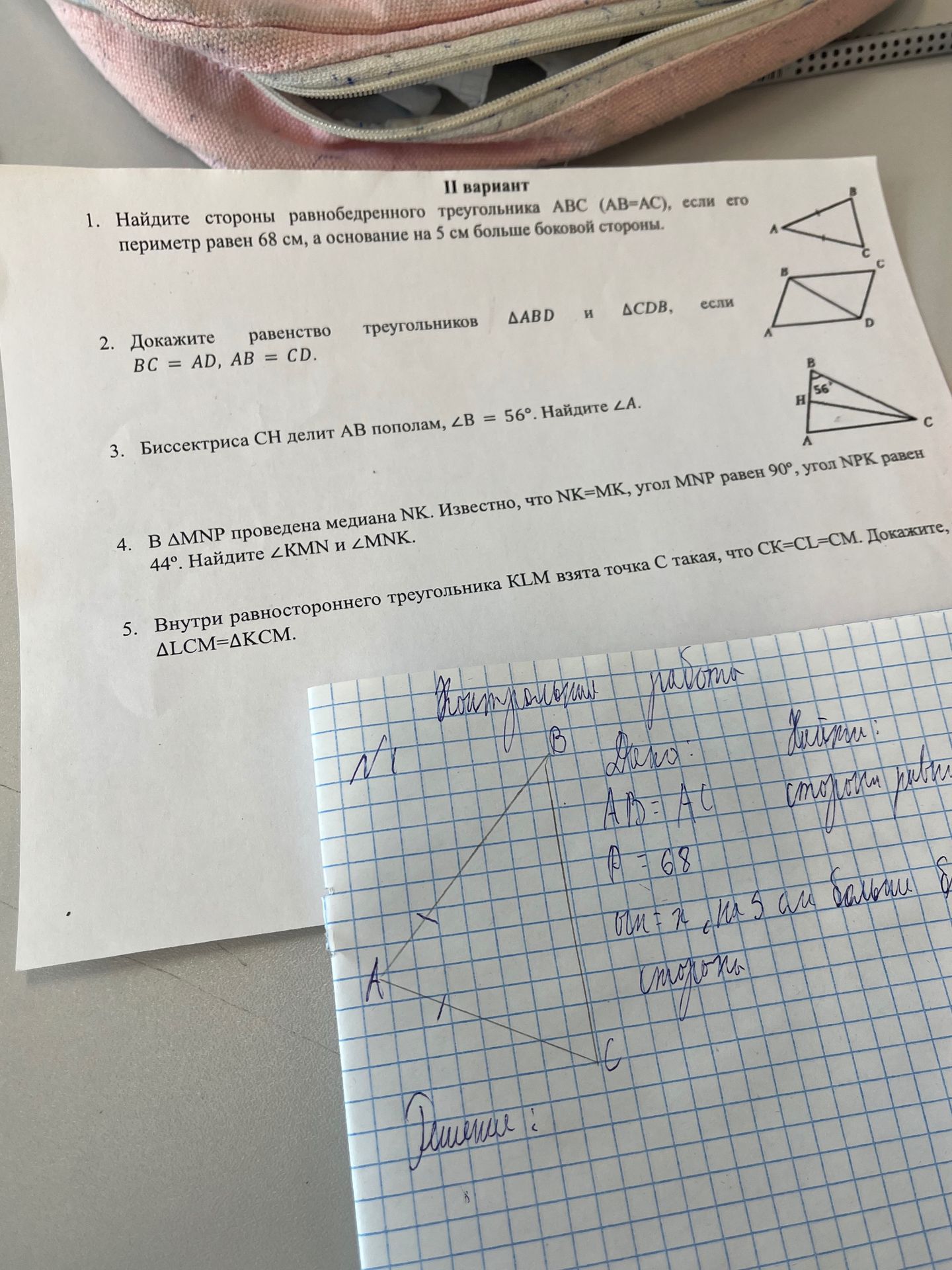
4. В \( \triangle MNP \) проведена медиана \( NK \). Известно, что \( NK=MK \), \( \angle MNP = 90^{\circ} \), \( \angle NPK = 44^{\circ} \). Найдите \( \angle KMN \) и \( \angle MNK \).
Ответ:
Решение:
Дано: \( \triangle MNP \), \( NK \) — медиана, \( NK=MK \), \( \angle MNP = 90^{\circ} \), \( \angle NPK = 44^{\circ} \).
Найти: \( \angle KMN \) и \( \angle MNK \).
- В \( \triangle NKP \) \( NK = MK \) (по условию). Это означает, что \( \triangle NKP \) — равнобедренный, так как \( NK \) является медианой, проведенной из вершины \( N \) к стороне \( MP \). Однако, условие \( NK=MK \) implies that \( K \) must be a point on \( MP \), and \( NK \) is a segment from \( N \) to \( K \). If \( NK \) is a median, \( K \) is the midpoint of \( MP \). The condition \( NK = MK \) means that \( K \) is also on the circle centered at \( N \) with radius \( NK \), and \( MK \) is a radius of this circle. This implies \( \triangle NKM \) is isosceles with \( NK=MK \). Let's assume that \( K \) is a point on \( MP \) and \( NK \) is the median. Then \( K \) is the midpoint of \( MP \). If \( NK = MK \), then \( K \) is the midpoint of \( MP \) and the length of the median is equal to the length of the segment from \( M \) to the midpoint \( K \). This means \( NK = MK = KP \) (since \( K \) is the midpoint, \( MK = KP \)). This is a property of a right-angled triangle where the median to the hypotenuse is half the hypotenuse. So, \( \triangle MNP \) is a right-angled triangle, and \( NK \) is the median to the hypotenuse \( MP \). Therefore, \( NK = MK = KP = \frac{1}{2} MP \).
- Since \( NK = MK \), \( \triangle NKM \) is an isosceles triangle with base \( NM \). Therefore, \( \angle KMN = \angle KNM \). Let \( \angle KMN = \angle KNM = y \).
- In \( \triangle MNP \), \( \angle MNP = 90^{\circ} \) and \( \angle MPN = 44^{\circ} \). The sum of angles in a triangle is \( 180^{\circ} \). So, \( \angle PMN = 180^{\circ} - 90^{\circ} - 44^{\circ} = 46^{\circ} \).
- Since \( \angle KMN = y \) and \( \angle PMN = 46^{\circ} \), we have \( y = 46^{\circ} \). So, \( \angle KMN = 46^{\circ} \) and \( \angle KNM = 46^{\circ} \).
- Now we need to find \( \angle MNK \). We know \( \angle MNK = \angle KNM = 46^{\circ} \) from the isosceles \( \triangle NKM \). However, this is \( \angle KNM \) which is part of \( \angle MNP \).
- Let's re-examine the problem. We have \( \triangle MNP \), \( NK \) is the median to \( MP \), so \( MK = KP \). We are given \( NK = MK \). Therefore, \( NK = MK = KP \).
- Consider \( \triangle NKP \). Since \( NK = KP \), it is an isosceles triangle. Therefore, \( \angle NKP = \angle KPN = \angle MPN = 44^{\circ} \).
- The angle \( \angle NKM \) is supplementary to \( \angle NKP \) because they form a straight line along \( MP \). So, \( \angle NKM = 180^{\circ} - \angle NKP = 180^{\circ} - 44^{\circ} = 136^{\circ} \).
- Now consider \( \triangle NKM \). We are given \( NK = MK \), so it is an isosceles triangle. The sum of angles in \( \triangle NKM \) is \( 180^{\circ} \). \( \angle KMN + \angle KNM + \angle NKM = 180^{\circ} \).
- We know \( \angle KMN = \angle PMN = 46^{\circ} \) (calculated in step 3).
- So, \( 46^{\circ} + \angle KNM + 136^{\circ} = 180^{\circ} \).
- \( \angle KNM + 182^{\circ} = 180^{\circ} \). This gives a negative angle, which is incorrect. Let's retrace.
Let's restart with the correct interpretation of the median and the given conditions.
- In \( \triangle MNP \), \( \angle MNP = 90^{\circ} \) and \( \angle MPN = 44^{\circ} \). The sum of angles in \( \triangle MNP \) is \( 180^{\circ} \), so \( \angle PMN = 180^{\circ} - 90^{\circ} - 44^{\circ} = 46^{\circ} \). This is \( \angle KMN \). So, \( \angle KMN = 46^{\circ} \).
- \( NK \) is the median to \( MP \), so \( K \) is the midpoint of \( MP \), which means \( MK = KP \).
- We are given \( NK = MK \). Therefore, \( NK = MK = KP \).
- Consider \( \triangle NKP \). Since \( NK = KP \), it is an isosceles triangle. The angle opposite to \( NK \) is \( \angle KPN = 44^{\circ} \). The angle opposite to \( KP \) is \( \angle KNP \). So, \( \angle KNP = \angle KPN = 44^{\circ} \).
- Now we need to find \( \angle MNK \). We know that \( \angle MNP = 90^{\circ} \). We can write \( \angle MNP = \angle MNK + \angle KNP \).
- Substituting the known values: \( 90^{\circ} = \angle MNK + 44^{\circ} \).
- \( \angle MNK = 90^{\circ} - 44^{\circ} = 46^{\circ} \).
So, \( \angle KMN = 46^{\circ} \) and \( \angle MNK = 46^{\circ} \).
Let's verify the condition \( NK=MK \) with these angles. In \( \triangle NKM \), \( \angle KMN = 46^{\circ} \) and \( \angle KNM = 46^{\circ} \). This means \( \triangle NKM \) is isosceles with \( NK = MK \). This matches the given condition.
Ответ: \( \angle KMN = 46^{\circ} \), \( \angle MNK = 46^{\circ} \).
Похожие
- 1. Найдите стороны равнобедренного треугольника АВС (АВ=АС), если его периметр равен 68 см, а основание на 5 см больше боковой стороны.
- 2. Докажите равенство треугольников \( \triangle ABD \) и \( \triangle CDB \), если \( BC = AD, AB = CD \).
- 3. Биссектриса СН делит АВ пополам, \( \angle B = 56^{\circ} \). Найдите \( \angle A \).
- 5. Внутри равностороннего треугольника KLM взята точка С такая, что СК=CL=CМ. Докажите, \( \triangle LCM = \triangle KCM \).
