
 Алгебра
 Английский
 Биология
 География
 Геометрия
 История
 Русский
 Обществознание
 Физика
 Химия
Химия Информатика
 Литература
 Математика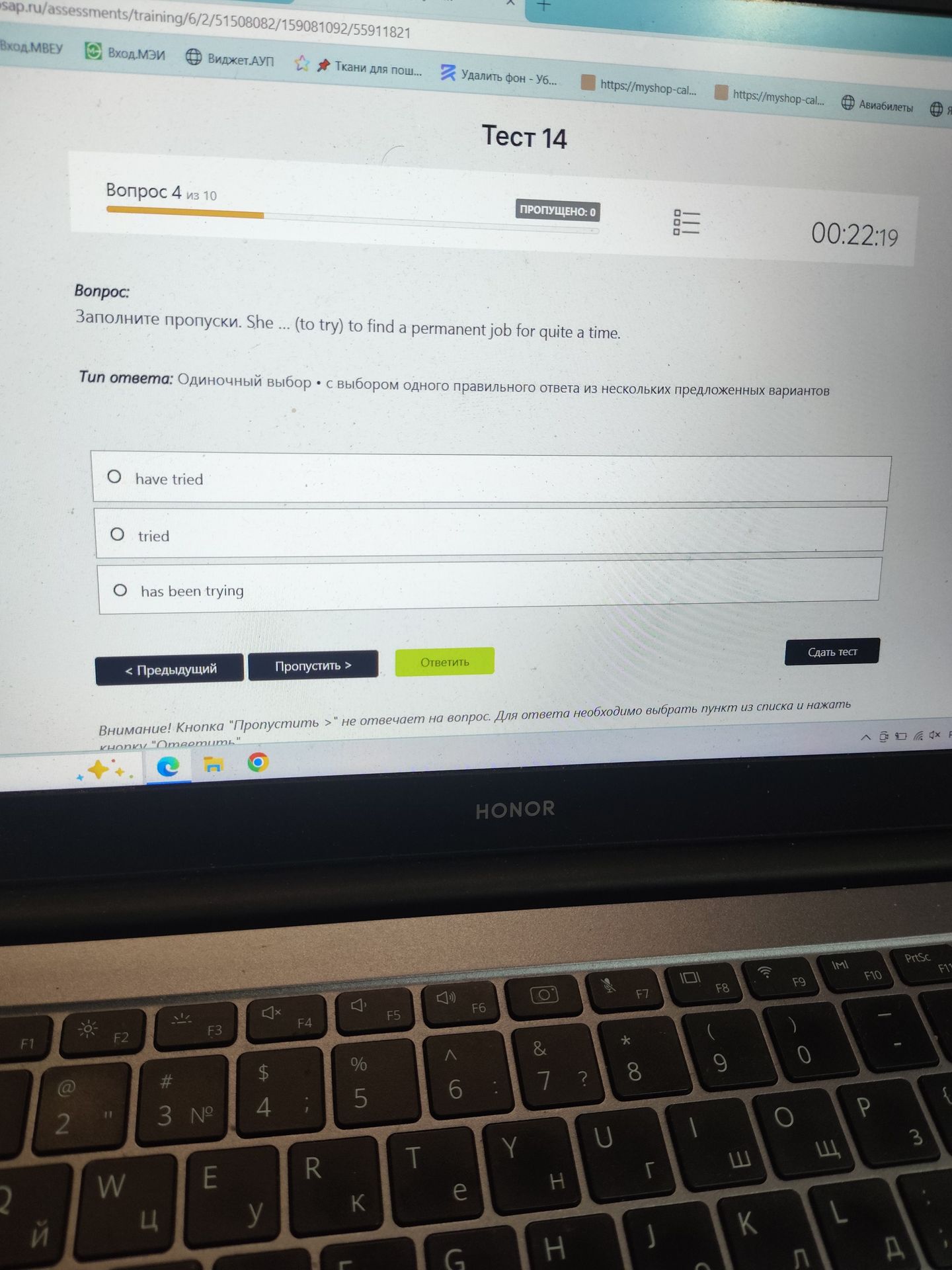
Ответ:
Решение:
Для заполнения пропуска необходимо выбрать глагол в правильной форме, которая соответствует контексту предложения. Предложение описывает действие, которое началось в прошлом и продолжается до настоящего момента (или имеет результат в настоящем), что указывает на использование Present Perfect Continuous или Present Perfect. Сравним варианты:
- have tried (Present Perfect): Используется для описания действий, которые произошли в прошлом, но имеют связь с настоящим.
- tried (Past Simple): Используется для описания завершенных действий в прошлом.
- has been trying (Present Perfect Continuous): Используется для описания действий, которые начались в прошлом и продолжаются до сих пор, с акцентом на длительность действия.
Учитывая фразу 'for quite a time' (довольно долгое время), наиболее подходящим является Present Perfect Continuous, так как он подчеркивает длительность процесса поиска работы. Однако, поскольку в вариантах есть и Present Perfect, рассмотрим, какой лучше подходит. 'She has tried to find a permanent job for quite a time' может означать, что она предприняла несколько попыток за долгое время. 'She has been trying to find a permanent job for quite a time' более естественно описывает непрекращающийся процесс поиска.
В данном случае, учитывая стандартные конструкции английского языка, вариант have tried (или has tried, если подлежащее 'She') является наиболее вероятным, хотя has been trying тоже возможен. Поскольку есть варианты 'have tried' и 'has been trying', и подлежащее 'She' (единственное число, 3-е лицо), то correct answer will be using 'has' instead of 'have'. Checking the options, 'have tried' is listed as a general form for plural or 'I/you', but given 'She', 'has tried' would be the correct form for Present Perfect. However, 'has been trying' is the correct form for Present Perfect Continuous. Given that the question is 'She ... (to try)', and we have options 'have tried', 'tried', 'has been trying', the most grammatically sound choice for 'She' is 'has been trying' if the focus is on the duration of the action, or 'has tried' if the focus is on the completion of attempts. Without further context or clarification on the intended tense, both could be argued. However, 'has been trying' is generally preferred for emphasizing ongoing duration. Let's re-evaluate based on the provided options and typical test design. 'Have tried' is provided, and if we assume it's a typo and should be 'has tried', then it's a possibility. But 'has been trying' is a complete and correct option. Let's go with the option that most strongly conveys the ongoing nature of the action suggested by 'for quite a time'.
A more thorough grammatical analysis suggests that both Present Perfect and Present Perfect Continuous can fit. However, Present Perfect Continuous emphasizes the duration and continuity of the action, which is well-supported by "for quite a time." Therefore, "has been trying" is the most appropriate choice.
Ответ: has been trying
