
 Алгебра
 Английский
 Биология
 География
 Геометрия
 История
 Русский
 Обществознание
 Физика
 Химия
Химия Информатика
 Литература
 Математика
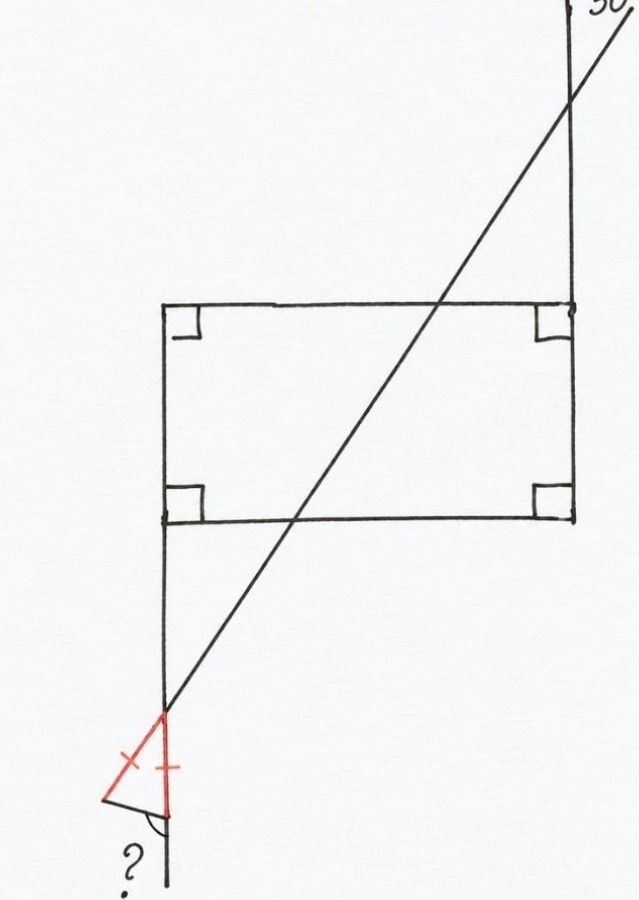
What is the value of the angle marked with a question mark?
Ответ:
Solution:
The image shows a rectangle intersected by a diagonal line. There is a red triangle at the bottom left corner. The triangle has two sides marked with tick marks, indicating they are equal in length. This means the red triangle is an isosceles triangle.
The angle marked with a question mark is one of the base angles of this isosceles triangle. Since the two sides are equal, the angles opposite those sides are also equal. Let the angle marked with a question mark be \( x \).
The diagonal line intersects the vertical line at a point. The rectangle has right angles indicated at its corners.
The angle adjacent to the red triangle and below the horizontal line of the rectangle appears to be a right angle (90 degrees) because it is formed by the vertical line and the bottom horizontal line of the rectangle, and the rectangle's sides are perpendicular.
The red triangle has one angle that is part of this right angle. The diagonal line also forms an angle with the vertical line. Let's consider the angles around the vertex where the red triangle is. The angle formed by the vertical line and the diagonal line is an acute angle.
Let's assume the rectangle's bottom side is parallel to the top side. The diagonal line acts as a transversal.
Let's focus on the red triangle. It's an isosceles triangle. Let the angle at the vertex where the diagonal intersects the vertical line be \( y \). The sum of angles in the red triangle is 180 degrees. So, \( x + x + y = 180 \) or \( 2x + y = 180 \).
Now let's look at the lines. There is a vertical line and a horizontal line that form a right angle. The bottom side of the rectangle is horizontal. The left side of the rectangle is vertical. The diagonal intersects the left vertical line.
There is a number '50' written near the top. This likely refers to an angle. It appears to be the angle formed by the diagonal line and the vertical line above the rectangle. If this is 50 degrees, then the angle formed by the diagonal and the vertical line *below* the rectangle would be supplementary if they formed a straight line, but they don't appear to. However, if we consider the angle formed by the diagonal and the vertical line, it could be 50 degrees.
Let's assume that the '50' refers to the angle between the diagonal and the vertical line *above* the rectangle. Then the alternate interior angle formed by the diagonal and the left vertical line *below* the rectangle would also be 50 degrees (if we consider the horizontal lines of the rectangle as parallel). However, the red triangle is below the horizontal line and the diagonal intersects the vertical line at the same vertex as the red triangle.
Let's re-examine the '50'. It is placed such that it is the angle between the diagonal and the vertical line. If we consider the entire vertical line, the angle above the horizontal line is 50 degrees. The angle formed by the diagonal and the vertical line below the horizontal line, which is inside the rectangle, would be \( 180 - 50 = 130 \) if they were supplementary, but they are not. They are alternate interior angles with respect to a transversal cutting two parallel lines. This does not seem to apply directly here.
Let's assume the '50' is the acute angle between the diagonal and the vertical line. The red triangle has one vertex on the vertical line. The diagonal passes through this vertex. Therefore, the angle \( y \) in the isosceles triangle \( 2x + y = 180 \) is the angle formed by the two sides of the triangle. One side is along the vertical line. The other side is along the diagonal line. So, \( y \) is the angle between the vertical line and the diagonal line. Thus, \( y = 50 \) degrees.
Now, we have the equation for the isosceles triangle: \( 2x + 50 = 180 \).
Solving for \( x \):
\( 2x = 180 - 50 \)
\( 2x = 130 \)
\( x = \frac{130}{2} \)
\( x = 65 \)
Therefore, the angle marked with a question mark is 65 degrees.
Final Check: The red triangle is isosceles with the angle between the two equal sides being 50 degrees. The other two angles (the base angles) must be equal. The sum of angles in a triangle is 180 degrees. So, \( 50 + 2x = 180 \). \( 2x = 130 \), \( x = 65 \). This is consistent.
Answer: 65°.
