
 Алгебра
 Английский
 Биология
 География
 Геометрия
 История
 Русский
 Обществознание
 Физика
 Химия
Химия Информатика
 Литература
 Математика
Вопрос:
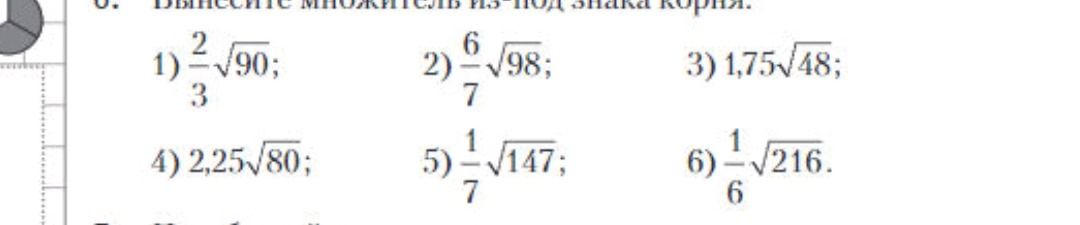
Вынесите множитель из-под знака корня: 1) \(\frac{2}{3}\sqrt{90}\) 2) \(\frac{6}{7}\sqrt{98}\) 3) \(1,75\sqrt{48}\) 4) \(2,25\sqrt{80}\) 5) \(\frac{1}{7}\sqrt{147}\) 6) \(\frac{1}{6}\sqrt{216}\)
Ответ:
Решение:
Чтобы вынести множитель из-под знака корня, нужно разложить число под корнем на множители так, чтобы один из них был полным квадратом.
- \(\frac{2}{3}\sqrt{90} = \frac{2}{3}\sqrt{9 \cdot 10} = \frac{2}{3}\sqrt{9} \cdot \sqrt{10} = \frac{2}{3} \cdot 3 \cdot \sqrt{10} = 2\sqrt{10}\)
- \(\frac{6}{7}\sqrt{98} = \frac{6}{7}\sqrt{49 \cdot 2} = \frac{6}{7}\sqrt{49} \cdot \sqrt{2} = \frac{6}{7} \cdot 7 \cdot \sqrt{2} = 6\sqrt{2}\)
- \(1,75\sqrt{48} = \frac{7}{4}\sqrt{16 \cdot 3} = \frac{7}{4}\sqrt{16} \cdot \sqrt{3} = \frac{7}{4} \cdot 4 \cdot \sqrt{3} = 7\sqrt{3}\)
- \(2,25\sqrt{80} = \frac{9}{4}\sqrt{16 \cdot 5} = \frac{9}{4}\sqrt{16} \cdot \sqrt{5} = \frac{9}{4} \cdot 4 \cdot \sqrt{5} = 9\sqrt{5}\)
- \(\frac{1}{7}\sqrt{147} = \frac{1}{7}\sqrt{49 \cdot 3} = \frac{1}{7}\sqrt{49} \cdot \sqrt{3} = \frac{1}{7} \cdot 7 \cdot \sqrt{3} = \sqrt{3}\)
- \(\frac{1}{6}\sqrt{216} = \frac{1}{6}\sqrt{36 \cdot 6} = \frac{1}{6}\sqrt{36} \cdot \sqrt{6} = \frac{1}{6} \cdot 6 \cdot \sqrt{6} = \sqrt{6}\)
Ответ: 1) \(2\sqrt{10}\); 2) \(6\sqrt{2}\); 3) \(7\sqrt{3}\); 4) \(9\sqrt{5}\); 5) \(\sqrt{3}\); 6) \(\sqrt{6}\).
