
 Алгебра
 Английский
 Биология
 География
 Геометрия
 История
 Русский
 Обществознание
 Физика
 Химия
Химия Информатика
 Литература
 Математика
Вопрос:
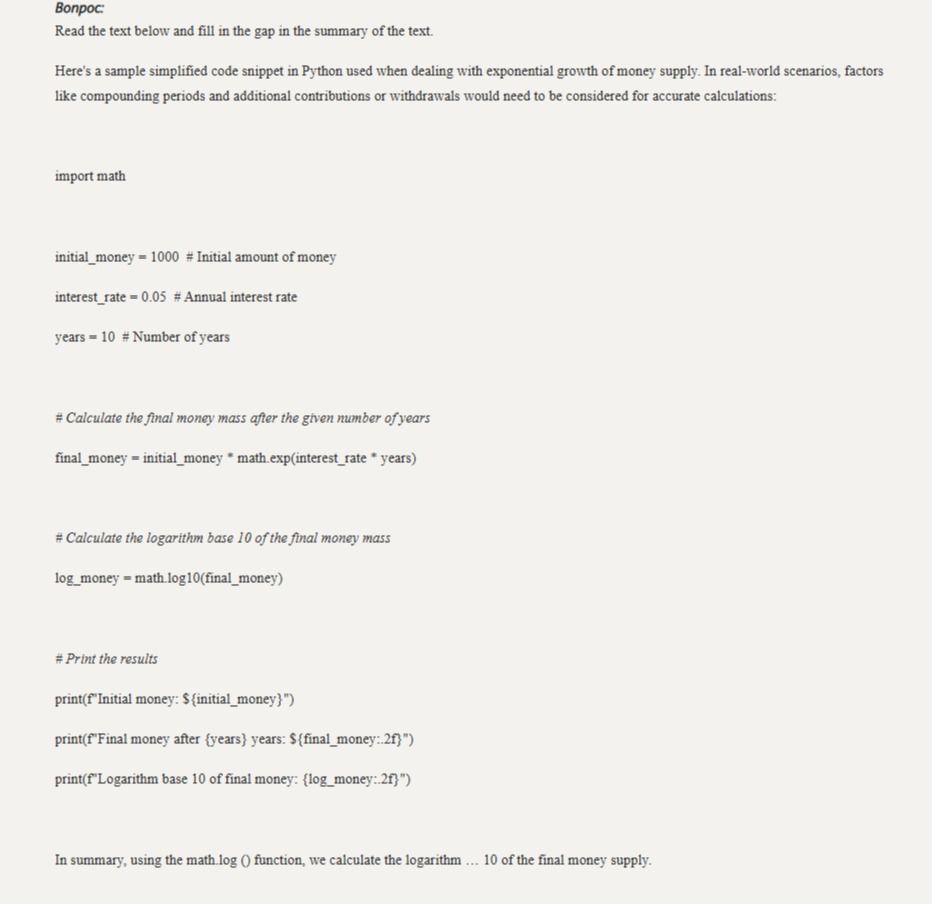
Read the text below and fill in the gap in the summary of the text. Here's a sample simplified code snippet in Python used when dealing with exponential growth of money supply. In real-world scenarios, factors like compounding periods and additional contributions or withdrawals would need to be considered for accurate calculations: import math initial_money = 1000 # Initial amount of money interest_rate = 0.05 # Annual interest rate years = 10 # Number of years # Calculate the final money mass after the given number of years final_money = initial_money * math.exp(interest_rate * years) # Calculate the logarithm base 10 of the final money mass log_money = math.log10(final_money) # Print the results print(f"Initial money: $$ {initial_money}") print(f"Final money after {years} years: $${final_money:.2f}") print(f"Logarithm base 10 of final money: {log_money:.2f}") In summary, using the math.log () function, we calculate the logarithm ... 10 of the final money supply.
Ответ:
Решение:
В предложении "In summary, using the math.log () function, we calculate the logarithm ... 10 of the final money supply." пропущено число, обозначающее основание логарифма, которое используется в коде для его вычисления. В коде для расчёта логарифма используется функция math.log10(), где число 10 указывает на основание логарифма.
Таким образом, пропущенное число – это 10.
Ответ: 10
