
 Алгебра
 Английский
 Биология
 География
 Геометрия
 История
 Русский
 Обществознание
 Физика
 Химия
Химия Информатика
 Литература
 Математика
Вопрос:
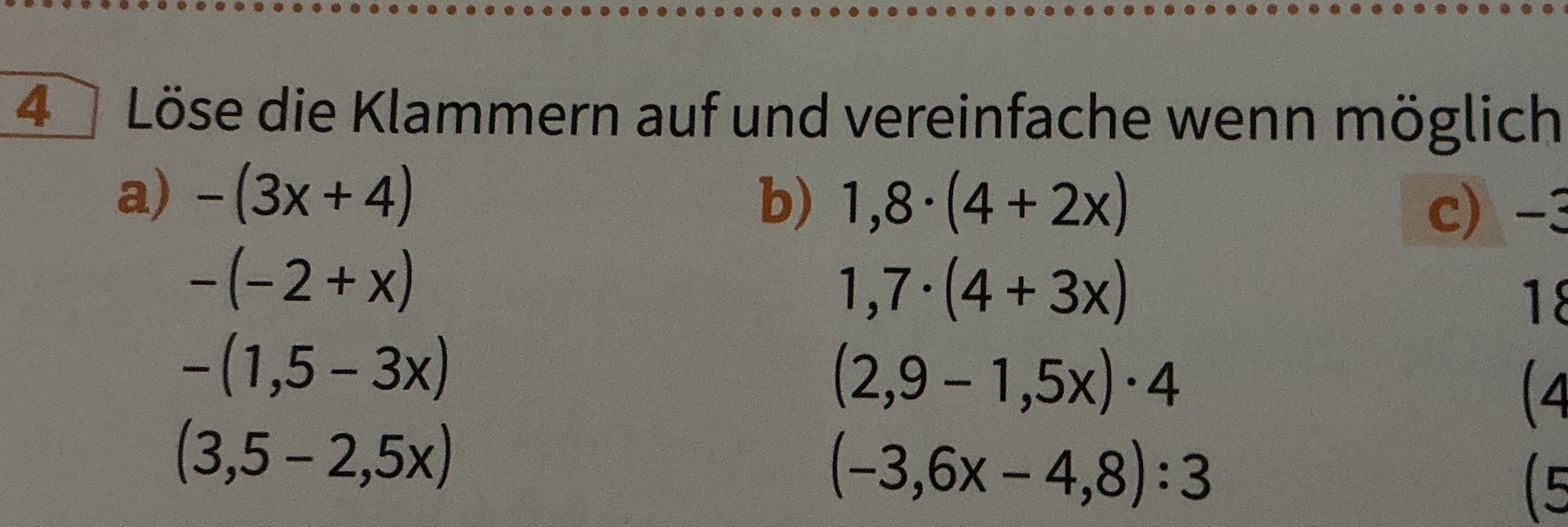
Löse die Klammern auf und vereinfache wenn möglich a) - (3x + 4) -(-2+x) -(1,5-3x) (3,5-2,5x) b) 1,8 · (4+2x) 1,7 · (4+3x) (2,9 – 1,5x) · 4 (-3,6x – 4,8) : 3 c) -3
Ответ:
Lösung:
a)
- \( -(3x + 4) = -3x - 4 \)
- \( -(-2 + x) = 2 - x \)
- \( -(1,5 - 3x) = -1,5 + 3x \)
- \( (3,5 - 2,5x) = 3,5 - 2,5x \)
b)
- \( 1,8 \cdot (4 + 2x) = 1,8 \cdot 4 + 1,8 \cdot 2x = 7,2 + 3,6x \)
- \( 1,7 \cdot (4 + 3x) = 1,7 \cdot 4 + 1,7 \cdot 3x = 6,8 + 5,1x \)
- \( (2,9 - 1,5x) \cdot 4 = 2,9 \cdot 4 - 1,5x \cdot 4 = 11,6 - 6x \)
- \( (-3,6x - 4,8) : 3 = -3,6x : 3 - 4,8 : 3 = -1,2x - 1,6 \)
c)
Der Ausdruck für c) ist unvollständig. Angenommen, es handelt sich um die Vereinfachung von \( -3 \cdot (4) \):
- \( -3 \cdot 4 = -12 \)
Oder angenommen, es handelt sich um \( -3x \):
- \( -3x \) (kann nicht weiter vereinfacht werden)
Ohne weitere Informationen kann c) nicht vollständig gelöst werden.
Antwort: a) -3x - 4; 2 - x; -1,5 + 3x; 3,5 - 2,5x. b) 7,2 + 3,6x; 6,8 + 5,1x; 11,6 - 6x; -1,2x - 1,6. c) Nicht vollständig lösbar ohne weitere Angaben.
