
 Алгебра
 Английский
 Биология
 География
 Геометрия
 История
 Русский
 Обществознание
 Физика
 Химия
Химия Информатика
 Литература
 Математика
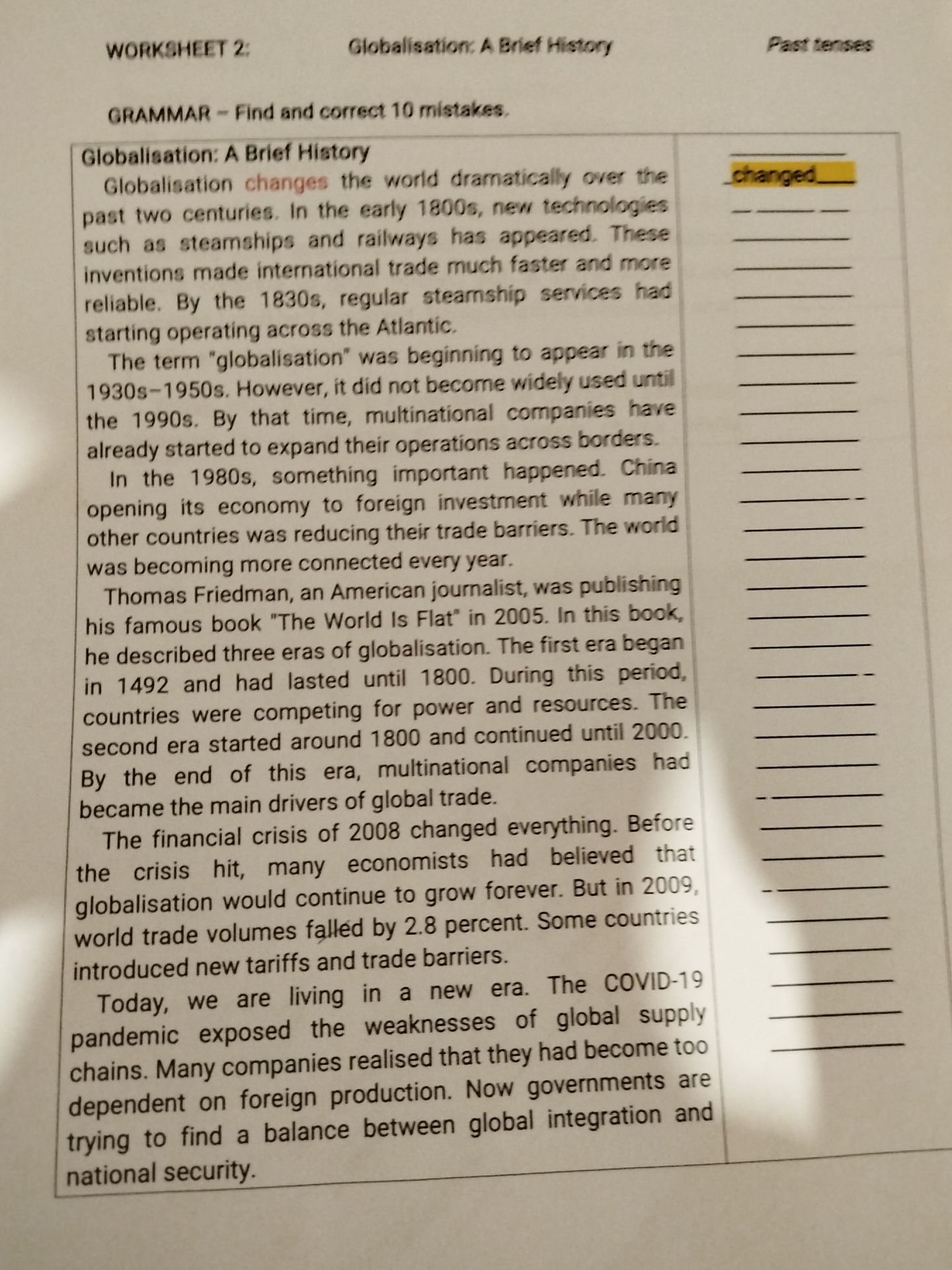
Globalisation changes the world dramatically over the past two centuries. In the early 1800s, new technologies such as steamships and railways has appeared. These inventions made international trade much faster and more reliable. By the 1830s, regular steamship services had starting operating across the Atlantic. The term "globalisation" was beginning to appear in the 1930s-1950s. However, it did not become widely used until the 1990s. By that time, multinational companies have already started to expand their operations across borders. In the 1980s, something important happened. China opening its economy to foreign investment while many other countries was reducing their trade barriers. The world was becoming more connected every year. Thomas Friedman, an American journalist, was publishing his famous book "The World Is Flat" in 2005. In this book, he described three eras of globalisation. The first era began in 1492 and had lasted until 1800. During this period, countries were competing for power and resources. The second era started around 1800 and continued until 2000. By the end of this era, multinational companies had became the main drivers of global trade. The financial crisis of 2008 changed everything. Before the crisis hit, many economists had believed that globalisation would continue to grow forever. But in 2009, world trade volumes falled by 2.8 percent. Some countries introduced new tariffs and trade barriers. Today, we are living in a new era. The COVID-19 pandemic exposed the weaknesses of global supply chains. Many companies realised that they had become too dependent on foreign production. Now governments are trying to find a balance between global integration and national security.
Ответ:
Исправленный текст:
Globalisation changed the world dramatically over the
past two centuries. In the early 1800s, new technologies
such as steamships and railways have appeared. These
inventions made international trade much faster and more
reliable. By the 1830s, regular steamship services had
started operating across the Atlantic.
The term "globalisation" was beginning to appear in the
1930s-1950s. However, it did not become widely used until
the 1990s. By that time, multinational companies had
already started to expand their operations across borders.
In the 1980s, something important happened. China opened
its economy to foreign investment while many
other countries were reducing their trade barriers. The world
was becoming more connected every year.
Thomas Friedman, an American journalist, was publishing
his famous book "The World Is Flat" in 2005. In this book,
he described three eras of globalisation. The first era began
in 1492 and had lasted until 1800. During this period,
countries were competing for power and resources. The
second era started around 1800 and continued until 2000.
By the end of this era, multinational companies had
become the main drivers of global trade.
The financial crisis of 2008 changed everything. Before
the crisis hit, many economists had believed that
globalisation would continue to grow forever. But in 2009,
world trade volumes fell by 2.8 percent. Some countries
introduced new tariffs and trade barriers.
Today, we are living in a new era. The COVID-19
pandemic exposed the weaknesses of global supply
chains. Many companies realised that they had become too
dependent on foreign production. Now governments are
trying to find a balance between global integration and
national security.
Ответ: changed, have, had, opened, were, fell.
