
 Алгебра
 Английский
 Биология
 География
 Геометрия
 История
 Русский
 Обществознание
 Физика
 Химия
Химия Информатика
 Литература
 Математика
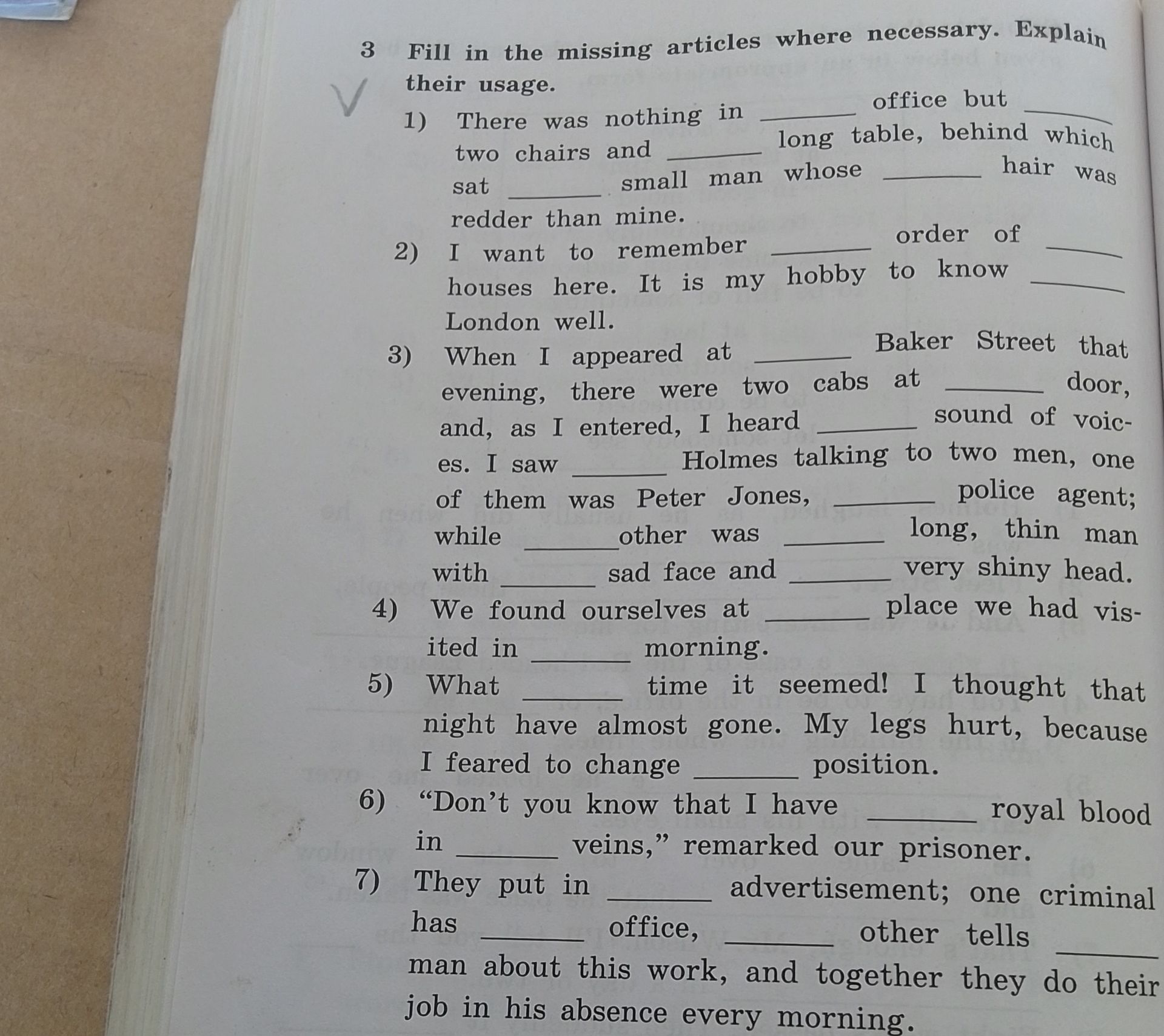
Fill in the missing articles where necessary. Explain their usage. 1) There was nothing in ___ office but two chairs and ___ long table, behind which sat ___ small man whose ___ hair was redder than mine. 2) I want to remember ___ order of ___ houses here. It is my hobby to know ___ London well. 3) When I appeared at ___ Baker Street that evening, there were two cabs at ___ door, and, as I entered, I heard ___ sound of voices. I saw ___ Holmes talking to two men, one of them was Peter Jones, ___ police agent; while ___ other was ___ long, thin man with ___ sad face and ___ very shiny head. 4) We found ourselves at ___ place we had visited in ___ morning. 5) What ___ time it seemed! I thought that ___ night had almost gone. My legs hurt, because I feared to change ___ position. 6) Don’t you know that I have ___ royal blood in ___ veins? remarked our prisoner. 7) They put in ___ advertisement; one criminal has ___ office, ___ other tells ___ man about this work, and together they do their job in his absence every morning.
Ответ:
There was nothing in the office but two chairs and a long table, behind which sat a small man whose — hair was redder than mine.
The is used for a definite, particular office; a introduces one of two chairs/tables and one small man. No article is used before an uncountable noun such as hair when speaking generally about its colour.
I want to remember the order of the houses here. It is my hobby to know — London well.
The is used because the order and the houses are definite in the given situation. No article is used before the name of a city.
When I appeared at — Baker Street that evening, there were two cabs at the door, and, as I entered, I heard the sound of voices. I saw — Holmes talking to two men, one of them was Peter Jones, a police agent; while the other was a long, thin man with a sad face and a very shiny head.
No article is normally used before a street name. The door and the sound are definite from the context. No article is used before a person’s surname when used as a proper name. A police agent and a long, thin man introduce people; the other refers to the second of two men. The same principle applies to a sad face and a very shiny head.
We found ourselves at the place we had visited in the morning.
The is used with a place already identified by a relative clause and with a particular part of the day.
What a time it seemed! I thought that the night had almost gone. My legs hurt, because I feared to change — position.
A time is used in an exclamatory construction. The night refers to the particular night in progress. No article is used with a person’s position in the expression change position.
Don’t you know that I have — royal blood in my veins? remarked our prisoner.
No article is used with the uncountable expression royal blood. The possessive determiner my, rather than an article, specifies whose veins are meant.
They put in an advertisement; one criminal has an office, the other tells a man about this work, and together they do their job in his absence every morning.
An advertisement and an office introduce singular countable nouns beginning with a vowel sound. The other identifies the second person of two. A man introduces an unspecified man.
