
 Алгебра
 Английский
 Биология
 География
 Геометрия
 История
 Русский
 Обществознание
 Физика
 Химия
Химия Информатика
 Литература
 Математика
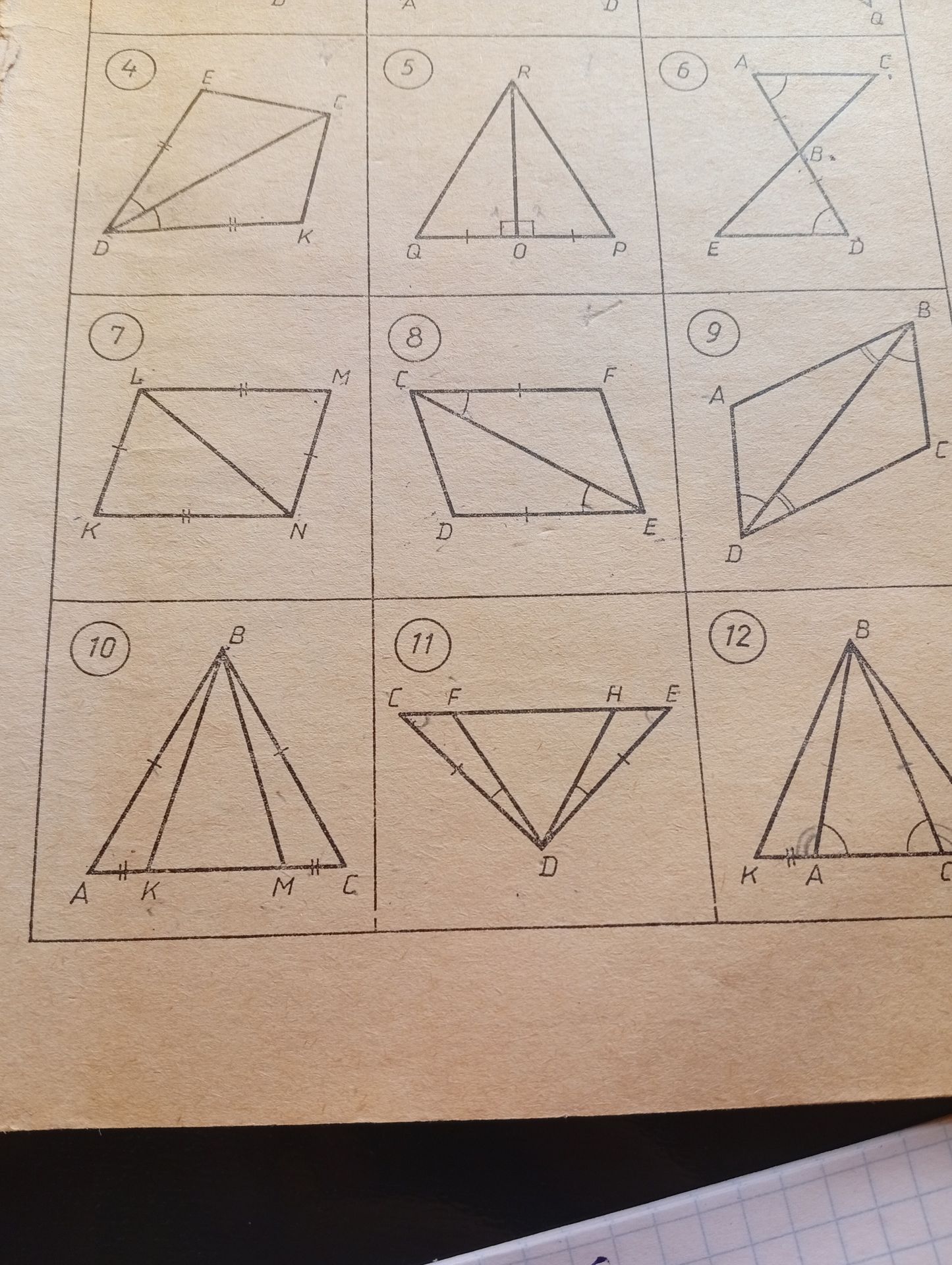
Figure 4. The given figure shows a quadrilateral DECK, where DE = EK and ∠EDC = ∠KDC. Prove that △DEC is an isosceles triangle.
Ответ:
Proof:
In the given quadrilateral DECK, we have:
- DE = EK (Given)
- ∠EDC = ∠KDC (Given)
Consider triangles △DEC and △DEK. However, the problem states to prove △DEC is isosceles, and the given information is about quadrilateral DECK. Let's re-examine the figure and the prompt.
The figure shows a quadrilateral DECK. We are given DE = EK and ∠EDC = ∠KDC. We need to prove that △DEC is an isosceles triangle, which means we need to show that two sides of △DEC are equal (e.g., DE = DC or EC = DC or DE = EC) or two angles are equal (e.g., ∠DEC = ∠DCE or ∠EDC = ∠ECD or ∠DEC = ∠EDC).
From the given information, we have DE = EK. This tells us about sides of △DEK, not △DEC directly.
We are given ∠EDC = ∠KDC. This means that the diagonal DK is the angle bisector of ∠EDC. This information is about angles in △DEK and possibly related to △DEC.
Let's assume the intention was to prove something about △DEK or a different property. However, sticking to the prompt to prove △DEC is isosceles:
We have DE = EK. If we can show that DK is also a median to side EK in △DEK, then DK would be the angle bisector and median, implying △DEK is isosceles with DE=EK, which is given. This doesn't directly help prove △DEC is isosceles.
Let's assume there is a typo and it meant to prove △DEK is isosceles or that DC = EC or DE = DC.
If we consider △DEC, we are given DE = EK and ∠EDC = ∠KDC. The markings on the sides of DE and EK are double ticks, and the markings on DC and EC are single ticks. This suggests DC = EC.
If DC = EC, then △DEC is an isosceles triangle by definition.
Let's proceed with the assumption that the single tick marks on DC and EC imply DC = EC.
Statement 1: DE = EK (Given)
Statement 2: DC = EC (Marked on the figure)
Statement 3: ∠EDC = ∠KDC (Given)
If DC = EC, then △DEC is isosceles by definition. However, the given information ∠EDC = ∠KDC might be intended to be used.
Let's consider the possibility that the question intended to ask something else, or there is missing information, or the figure markings are crucial and imply DC = EC.
Given the markings on the figure, it is highly probable that DC = EC is implied by the single tick marks.
Proof based on figure markings:
- In △DEC, the sides DC and EC are marked with single tick marks. This implies that DC = EC.
- A triangle with two equal sides is an isosceles triangle.
- Therefore, △DEC is an isosceles triangle.
The information DE = EK and ∠EDC = ∠KDC might be for a different proof or context, or intended to lead to a proof of congruence for other triangles if more points were involved.
If we have to use all information:
Consider △DEK and △DCK. We have DE=EK and ∠EDC=∠KDC. This is not enough for congruence.
Let's assume the question meant to prove △DEK is isosceles using the angle bisector property.
If DK is the angle bisector of ∠EDC and DE = EK, this doesn't directly apply to proving △DEC is isosceles without further information or assumptions about point K's relation to DE and EC.
Given the visual cues (single tick marks on DC and EC), the most straightforward interpretation is that DC = EC, making △DEC isosceles.
Conclusion based on visual evidence: The figure indicates DC = EC through tick marks. Therefore, △DEC is an isosceles triangle.
If the intention was to use the angle bisector property and side equality in a larger figure, more context or a different question would be needed.
Final Answer based on the most direct interpretation of the markings on △DEC:
Statement: In △DEC, DC = EC (indicated by single tick marks on the sides).
Conclusion: Therefore, △DEC is an isosceles triangle.
Похожие
- Figure 5. Given △ROP, RO = OP, and RO ⊥ OP. What is the measure of ∠ORP?
- Figure 6. Given △ABC and △EDB, ∠BAC = ∠BED, AB = ED, and AC = EB. Prove that △ABC ≅ △EDB.
- Figure 7. Given parallelogram LMCF, with LM = MF and ∠MLF = 90°. Prove that LMCF is a square.
- Figure 8. Given △CDF, CD = CF, and ∠CDF = ∠CFD. Point E is on CD and point F is on DF. Line segment CE is drawn. If △CDE ≅ △CFE, prove that △CDF is an isosceles triangle.
- Figure 9. Given quadrilateral ABCD, with AB || DC and AD || BC. Also, ∠ADC = ∠BCD. Prove that ABCD is a square.
