
 Алгебра
 Английский
 Биология
 География
 Геометрия
 История
 Русский
 Обществознание
 Физика
 Химия
Химия Информатика
 Литература
 Математика
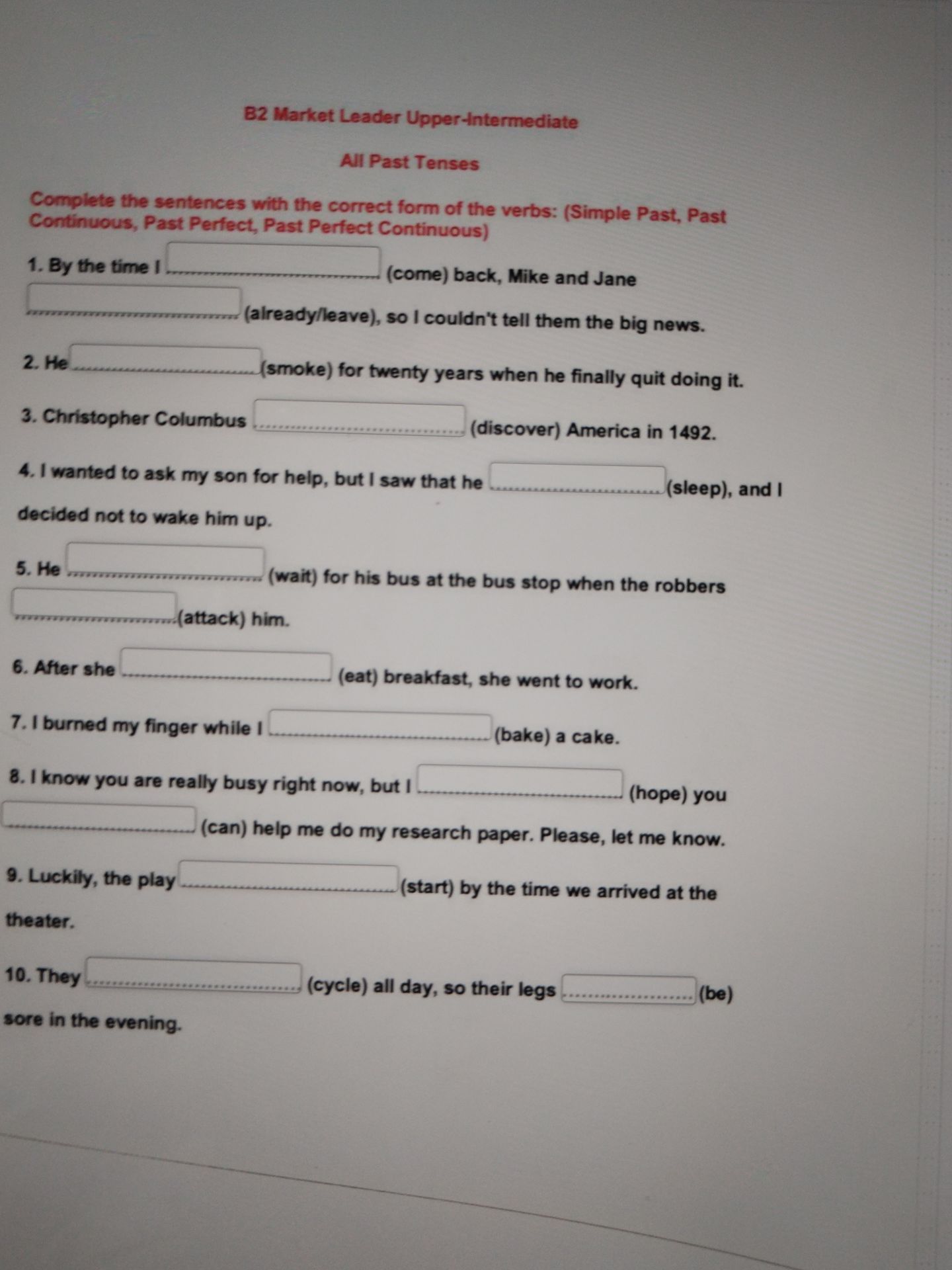
Complete the sentences with the correct form of the verbs: (Simple Past, Past Continuous, Past Perfect, Past Perfect Continuous)
Ответ:
1. By the time I arrived (come) back, Mike and Jane had already left (already/leave), so I couldn't tell them the big news.
Explanation: We use the Past Perfect (had left) to describe an action that happened before another action in the past (arrived).
2. He had been smoking (smoke) for twenty years when he finally quit doing it.
Explanation: We use the Past Perfect Continuous (had been smoking) to emphasize the duration of an action that continued up until a certain point in the past.
3. Christopher Columbus discovered (discover) America in 1492.
Explanation: We use the Simple Past (discovered) for a completed action at a specific time in the past.
4. I wanted to ask my son for help, but I saw that he had been sleeping (sleep), and I decided not to wake him up.
Explanation: We use the Past Perfect Continuous (had been sleeping) to describe an action that was in progress before another past action (saw).
5. He was waiting (wait) for his bus at the bus stop when the robbers attacked (attack) him.
Explanation: We use the Past Continuous (was waiting) for an action in progress when another action interrupted it (attacked). The interrupting action is in the Simple Past.
6. After she had had (eat) breakfast, she went to work.
Explanation: We use the Past Perfect (had had) for an action that was completed before another past action (went to work).
7. I burned my finger while I was baking (bake) a cake.
Explanation: We use the Past Continuous (was baking) for an action that was in progress when another event happened (burned my finger).
8. I know you are really busy right now, but I hope (hope) you (can) help me do my research paper. Please, let me know.
Explanation: This sentence describes a present hope. The second part is a present ability/request, so the verbs are in the present tense.
9. Luckily, the play had started (start) by the time we arrived at the theater.
Explanation: We use the Past Perfect (had started) for an action that was completed before another past action (arrived).
10. They had been cycling (cycle) all day, so their legs were (be) sore in the evening.
Explanation: We use the Past Perfect Continuous (had been cycling) to emphasize the duration of an action that continued up until a certain point in the past (their legs were sore). The soreness is a result of that action and is described in the Simple Past.
