
 Алгебра
 Английский
 Биология
 География
 Геометрия
 История
 Русский
 Обществознание
 Физика
 Химия
Химия Информатика
 Литература
 Математика
Analyze the provided Python code and its output.
Ответ:
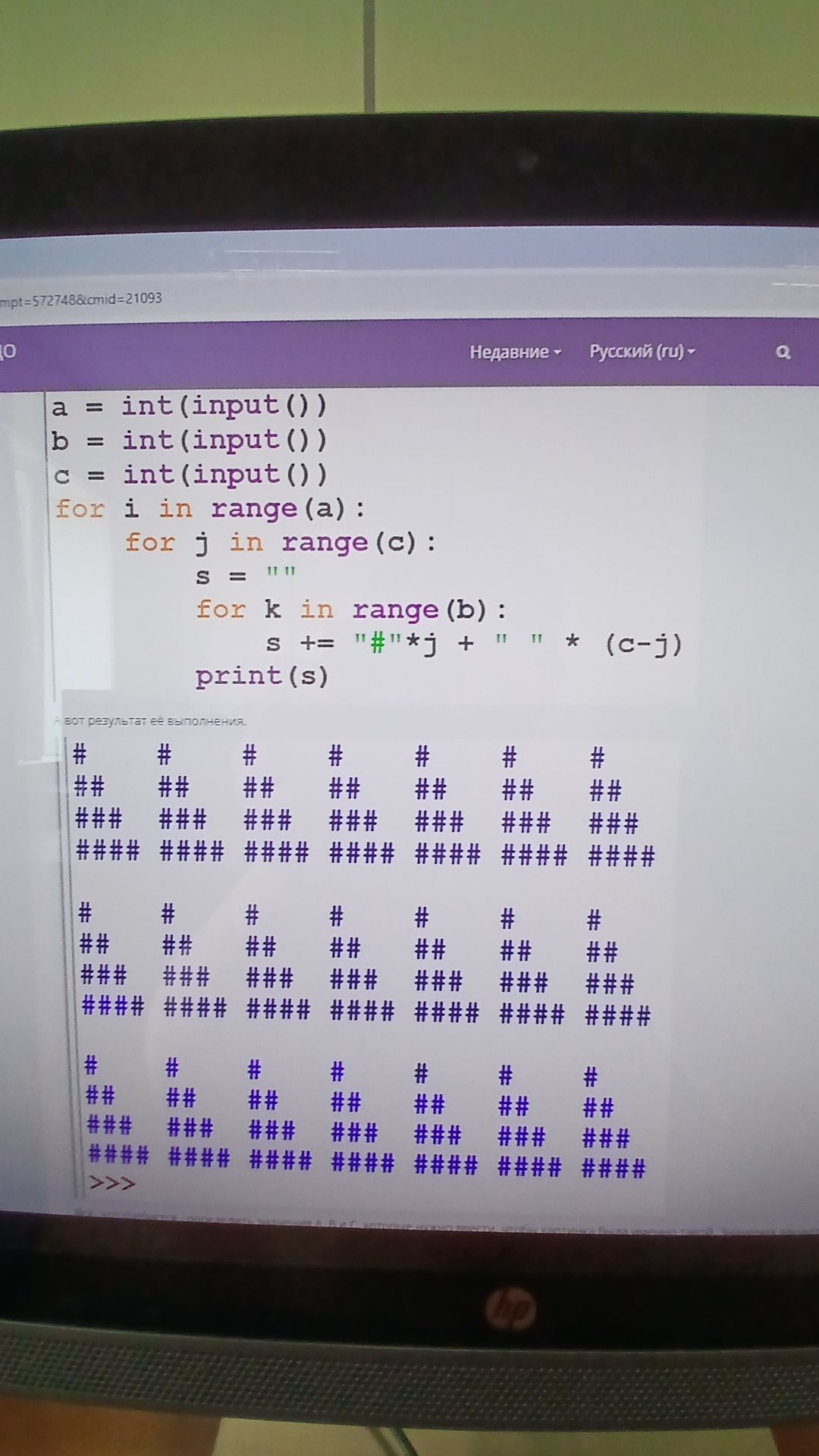
Python Code Analysis:
The Python code takes three integer inputs: a, b, and c.
It then enters a nested loop structure:
- The outer loop iterates
atimes (controlled by variablei). - The middle loop iterates
ctimes (controlled by variablej). - Inside the middle loop, a string
sis initialized to empty twice. - The inner loop iterates
btimes (controlled by variablek). - In the inner loop, the string
sis appended with a sequence of characters: a hash symbol (#) multiplied byj, followed by a space, then another space, and finally multiplied by(c-j). This part of the code seems to have a logical error or misunderstanding as it's concatenating strings inside a loop that is meant for numeric calculation and the logic of the string construction seems unusual.Finally, the code prints the strings.Output Analysis:
The output shows a pattern of hash symbols (#) printed in rows and columns. This pattern is likely generated by the
print(s)statement at the end of the loops. However, the provided code snippet and the printed output suggest a potential mismatch or a misunderstanding in how the stringsis constructed within the loops, especially the lines += "#"*j + " " + " " * (c-j). The visual output appears to be a pattern of increasing and then decreasing density of '#' characters, which is typical for some graphical representations in text, but the specific Python logic shown to produce it is not straightforward and might have a typo or logical flaw as written.Given the specific output, it seems like the code intended to print a pattern related to the loops, but the precise construction of 's' within the inner loop, particularly `"#"*j + " " + " " * (c-j)`, doesn't directly and obviously produce the seen output without further context or correction.
