
 Алгебра
 Английский
 Биология
 География
 Геометрия
 История
 Русский
 Обществознание
 Физика
 Химия
Химия Информатика
 Литература
 Математика
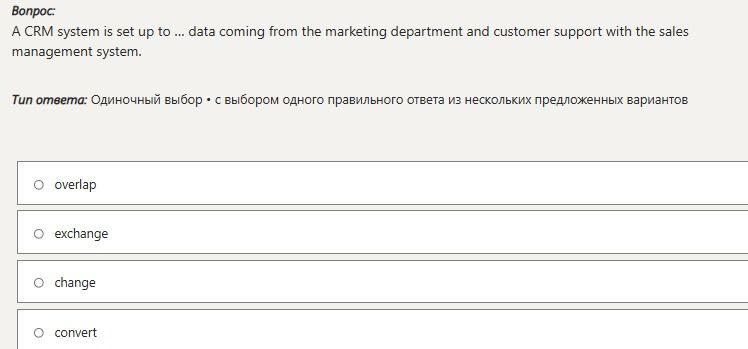
A CRM system is set up to ... data coming from the marketing department and customer support with the sales management system.
Ответ:
Solution:
A CRM (Customer Relationship Management) system is designed to manage and analyze customer interactions and data throughout the customer lifecycle. It aims to improve business relationships with customers, assist in customer retention, and drive sales growth. When data comes from different departments like marketing and customer support, the CRM system's purpose is to consolidate, organize, and potentially transform this data to provide a unified view and facilitate better decision-making and actions within the sales management system.
Considering the options:
- Overlap: This implies that data from different departments might be redundant or coincide, which is not the primary purpose of a CRM. While some overlap might occur, it's not the core function.
- Exchange: While data is exchanged between systems and departments, 'exchange' alone doesn't fully capture the comprehensive function of a CRM in integrating and utilizing this data for sales management.
- Change: Data might be changed or updated within the CRM, but 'change' is too general and doesn't specify the purpose of this change in relation to other departments and sales.
- Convert: In the context of data processing and systems integration, 'convert' often implies transforming data from one format or state to another, or more broadly, making raw data useful for a specific purpose. A CRM system takes raw data from marketing and support and 'converts' it into actionable insights and structured information for the sales management system. This conversion allows for better analysis, segmentation, and targeted sales efforts.
Therefore, the most fitting word to describe the role of a CRM system in integrating data from marketing and customer support for the sales management system is to 'convert' it into a usable format or actionable intelligence.
Answer: convert
