
 Алгебра
 Английский
 Биология
 География
 Геометрия
 История
 Русский
 Обществознание
 Физика
 Химия
Химия Информатика
 Литература
 Математика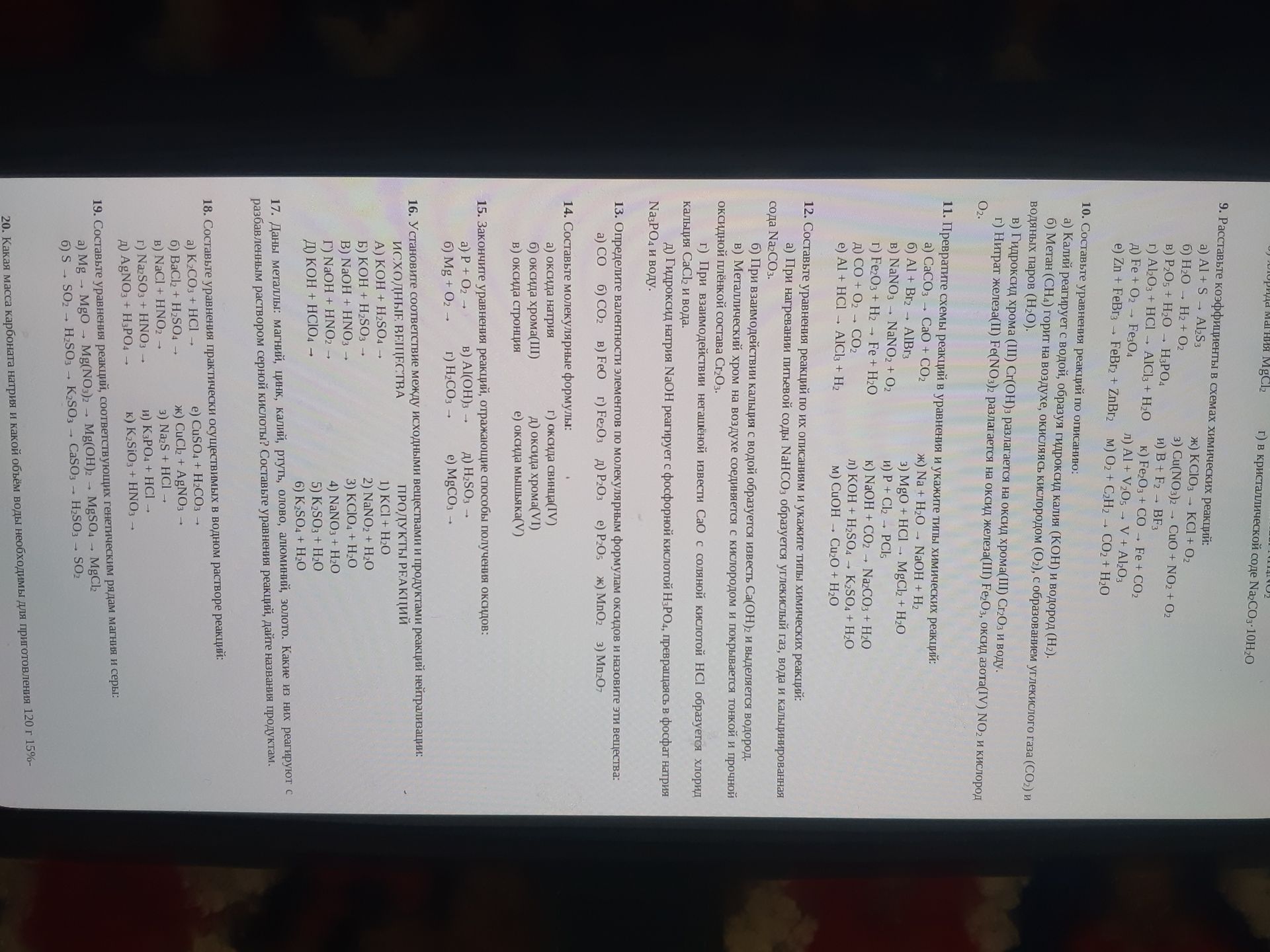
Ответ:
Решение:
Реакции осуществимы, если образуется осадок, газ или слабый электролит (вода).
- \( \text{K}_2\text{CO}_3 + 2\text{HCl} \rightarrow 2\text{KCl} + \text{CO}_2 \uparrow + \text{H}_2\text{O} \)
- \( \text{BaCl}_2 + \text{H}_2\text{SO}_4 \rightarrow \text{BaSO}_4 \downarrow + 2\text{HCl} \)
- \( \text{CuSO}_4 + \text{H}_2\text{CO}_3 \rightarrow \text{CuCO}_3 \downarrow + \text{H}_2\text{SO}_4 \)
- \( \text{CuCl}_2 + 2\text{AgNO}_3 \rightarrow 2\text{AgCl} \downarrow + \text{Cu(NO}_3)_2 \)
- \( \text{NaCl} + \text{HNO}_2 \rightarrow \text{NaNO}_2 + \text{HCl} \) (реакция не идет, т.к. продукты - сильные электролиты)
- \( \text{Na}_2\text{S} + 2\text{HCl} \rightarrow 2\text{NaCl} + \text{H}_2\text{S} \uparrow \)
- \( \text{Na}_2\text{SO}_3 + 2\text{HNO}_3 \rightarrow 2\text{NaNO}_3 + \text{SO}_2 \uparrow + \text{H}_2\text{O} \)
- \( \text{K}_3\text{PO}_4 + 3\text{HCl} \rightarrow 3\text{KCl} + \text{H}_3\text{PO}_4 \)
- \( \text{K}_2\text{SiO}_3 + 2\text{HNO}_3 \rightarrow 2\text{KNO}_3 + \text{H}_2\text{SiO}_3 \downarrow \)
- \( 3\text{AgNO}_3 + \text{H}_3\text{PO}_4 \rightarrow \text{Ag}_3\text{PO}_4 \downarrow + 3\text{HNO}_3 \)
